
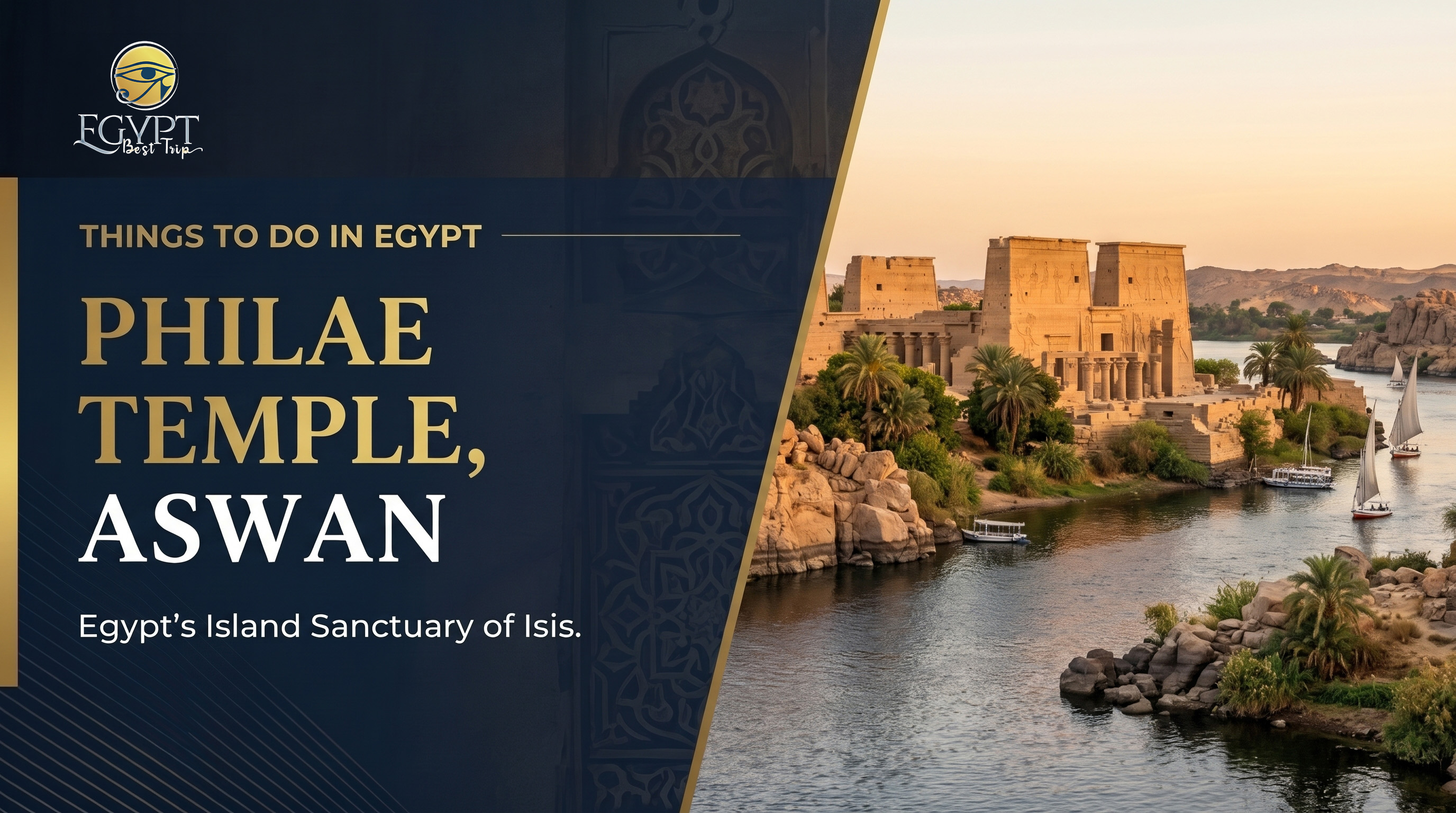
A Temple Saved from Flooding
Originally, Philae Temple was located on Philae Island, which was a religious sanctuary that had been worshipped in for over 1000 years. It includes monuments from the Pharaonic period, Greek period, Roman period and Christian period meaning it really displays the history of Egypt in one architectural location. However, when the Aswan Low Dam was built in early 1900s most of the island became partially submerged. Then in the 1960s when the Aswan High Dam was built the temple was in serious danger since it was going to be permanently submerged in Lake Nasser!
Between 1972 and 1980 'the greatest archaeology rescue operation of all time' occurred led by UNESCO. The whole temple complex was taken apart and recorded. It was reconstructed on Agilkia Island about 500 metres away. This was an extremely careful process as the temple pieces were kept at el-Shallal for years whilst checking the inscriptions. Finally, in March 1981 the temple was opened to the public again. One Egyptian archaeologist said "These temples were a miracle to build in ancient times. Moving them like this was also a miracle."
Why Philae Is Important?
The main temple on site is the Temple of Isis which was started by Ptolemy II Philadelphus (285-246 BC). The Ptolemies were Greek but adopted the Egyptian religion. The temple has incredible reliefs on the walls of kings worshipping Isis, Osiris and Horus. The mammisi shows the birth of Horus with Isis breastfeeding him in the marshes.
This temple is unique because the Isis cult was followed here even after Christianity was widespread in Egypt and even survived until the reign of Byzantine Emperor Justinian I (527-565 AD) when he ordered all pagan temples to be shut. A priest named Esmet-Akhom carved the final dated hieroglyphics in Egypt in 394AD. The temple was later converted to a Christian church and many ancient reliefs were destroyed, with crosses carved in where there used to be ankh symbols.
What To See?
First Pylon. This is the entrance to the temple from the water with huge carvings depicting pharaohs offering to Isis.
Trajan's Kiosk. This is the most photographed part of the temple. It is a beautiful open-air pavilion with columns. It is known as the Pharaoh's Bed and was built during the rule of Emperor Trajan (98-117AD). It used to be the front of the temple complex. It creates a lovely reflection in the Nile.
Temple of Hathor. This is a small temple built by Ptolemy VI and Augustus. Look up to see the heads of Hathor on top of the columns. She is the goddess of music and love.
Nilometer, Hadrian's Gate, Birth House, Eastern Colonnade and Western Colonnade. There is plenty to see here so be sure to spend 1.5-2 hours.
How To Get There?
You will need to take a boat to get to the temple. Travel to the Shellal Jetty (also known as the Philae Temple ticket office) which is south of Aswan. Purchase your tickets to enter the temple. You will need to haggle with a boatman to take you across the water to Agilkia island. It takes around 10-15 minutes.
Opening Times
Winter Opening Times are around 7am-4pm. Summer Opening Times are around 7am-5pm. Some sources say they open as early as 6am. It is best to check locally.
Best Time To Visit
The best time to visit is early morning. It is a lovely time to visit as there is little heat and the lighting is soft. There will also be far fewer tour groups. Late afternoon is also a lovely time to visit as the stones will be glowing with a golden color. This is a great time for photographers. However, midday in Summer can be very hot. Aswan can be over 40°C and there is little shade on the island. Be sure to bring water, a hat and sunscreen.
Sound and Light Show
If you have the time, it is worth visiting in the evening. The temple is lit up and creates lovely reflections on the dark water. The story comes to life with the narration. This is a completely different experience and many travellers say it is one of the highlights of their trip to Aswan.
Tips
Combine with other attractions in Aswan. The High Dam and Unfinished Obelisk are nearby. If you have the time, visit a Nubian Village across the river to experience a contrasting culture. Many travelers combine with a felucca cruise. This traditional sailing boats are perfect!
Stay nearby. The Old Nubian Guest House Philae & Restaurant has spectacular views of the Nile. They will provide a boat to come and collect you.
Be respectful. The floor can be slippery near the water, especially in the mornings with dew. Remember, you are walking through a temple that almost got lost! The graffiti, destroyed reliefs and crosses are not a bad thing. These are marks left behind by history. This gives the temple more of a living feel rather than a museum.
Philae Temple is a great place to visit if you are aware of the story behind it. It is a beautiful temple with the island, kiosk by the river and high pylons creating a picture perfect scene. However, the true magic is that it represents a culture willing to protect their sacred temples! The goddess Isis was worshipped here for centuries and the temple has now survived the flooding! Be sure to visit early and take your time to let the island work its magic!
Philae Temple is not just another place to see in Egypt. It is a stunning temple dedicated to the goddess of magic and motherhood, Isis. Not many tourists realize that the temple we see today was moved stone by stone from a watery tomb! This helps to create one of the most poignant archaeological sites in Egypt.


