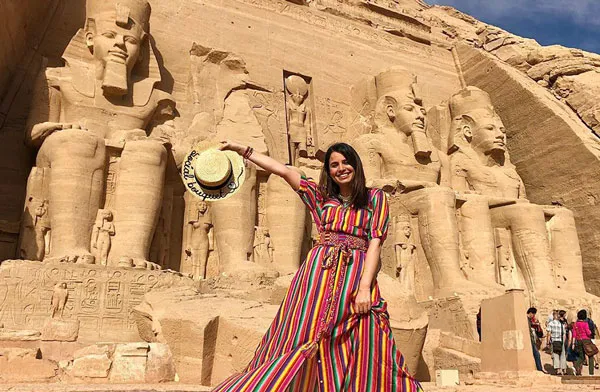
If you're staying in Sharm, Dahab or Taba, Jordan is closer than you think. One boat ride across the Gulf of Aqaba, and the same afternoon you can be in the red desert of Wadi Rum. The next morning, you walk into Petra. Two days, two World Heritage Sites, and one of the most beautiful short trips you can take from Egypt.
This guide walks you through every place on the way, in the order you'll see them. For each one, you'll find what it is, why it matters, and a small tip to enjoy it more.
The crossing: Taba to Aqaba
Your trip starts on the water. From Taba, the boat crosses the northern tip of the Gulf of Aqaba to Jordan's only coastal city. On a clear day you can see four countries around the gulf at once.
Tip: keep your passport in your hand, not in your bag. Our team meets you at the port and handles the border steps with you, so all you need to do is enjoy the view.
Wadi Rum: the Valley of the Moon
About an hour's drive from Aqaba, the road opens onto a landscape that doesn't look like Earth. Wadi Rum is a wide valley of red sand, cut between huge cliffs of sandstone and granite. Locals call it the Valley of the Moon, and when you see it, you'll understand why.
Wadi Rum became a UNESCO World Heritage Site in 2011, as a mixed site, valued for both its nature and its human history. People have lived here for thousands of years, and they left rock carvings and inscriptions in the canyons. Bedouin families still live here today, and they are the ones who drive you through it.
What you'll see on the jeep safari. Your Bedouin driver chooses the route by the light and the season. Stops often include:
- Red sand dunes, soft enough to climb barefoot, with a wide view from the top.
- Narrow canyons, where the cliffs close in and the air turns cool.
- Ancient rock carvings of camels, people and old desert scripts.
- Natural rock arches and bridges, shaped by wind over thousands of years.
- Sunset over the desert, when the cliffs turn from orange to deep red.
Tip: sit with your driver for a glass of sweet Bedouin tea. Ask him about his family and the desert. Some of the best moments of this trip are these quiet conversations, not the photos.
Your night near Petra
After the desert, you drive north to the area of Wadi Musa, the town at the gate of Petra. You'll have dinner and a good night's sleep, so you walk into Petra fresh in the morning. That rest matters: Petra is a full day on your feet.
Petra: the city carved in rose-red rock
Petra was the capital of the Nabataeans, Arab traders who grew rich on the caravan routes more than 2,000 years ago. They carved temples, tombs and houses straight into the soft pink sandstone. The city flourished in the 1st century AD, was forgotten by the outside world for centuries, and was made known in Europe again in 1812 by the Swiss traveller Johann Ludwig Burckhardt. It has been a UNESCO World Heritage Site since 1985.
Here are the places you'll walk through, in order.
The Siq: the walk in
There is no road into Petra. You walk in through the Siq, a natural gorge about 1.2 km long. The walls rise high on both sides, sometimes so close you can almost touch both. Look down along the walls and you'll see the old Nabataean water channels that once carried water into the city.
Tip: walk slowly near the end. The Siq saves its best moment for last.
The Treasury (Al-Khazneh)
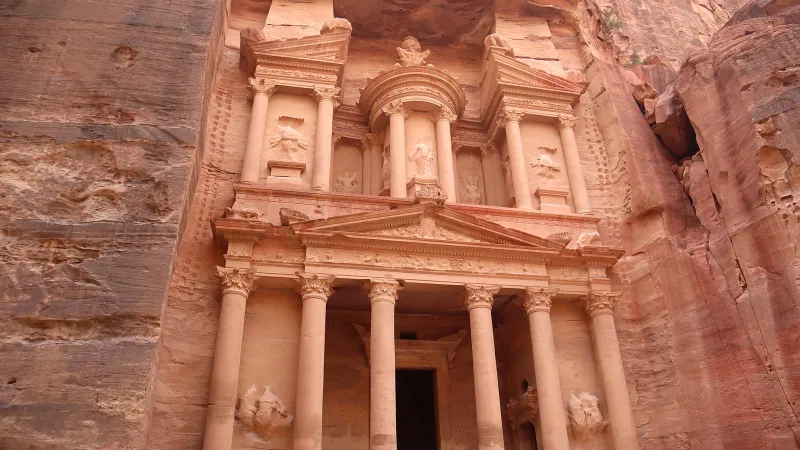
At the end of the Siq, through a narrow crack in the rock, you get your first look at the Treasury. Its carved façade is about 40 metres tall, glowing pink in the morning sun. This is the moment most people fall in love with Petra.
Despite its name, it was never a bank. Most researchers believe it was a royal tomb, probably for King Aretas IV, the most successful Nabataean ruler. The name comes from an old legend that treasure was hidden in the stone urn at the top.
Tip: arrive early. In the morning, the light falls on the façade and the square in front is quieter.
The Street of Facades and the Theatre
Past the Treasury, the valley opens up. On your left, rows of tombs are carved into the cliff, one next to the other, like houses on a street. A little further on is the Theatre, cut into the mountain and big enough for thousands of people.
The Royal Tombs
On the right side of the valley, high on the cliff, stand the Royal Tombs. These are some of the largest monuments in Petra. Climb the steps to the Urn Tomb and look at the ceiling inside: the natural colours of the rock swirl in red, pink, white and gold. The view of the city from the terrace is one of the best in Petra.
The Colonnaded Street and the Great Temple
This was the city's main street. Columns once lined both sides, with shops and temples behind them. Walking here, it is easy to imagine the city full of traders, camels and spices from Arabia and India.
The Monastery (Ad Deir), if you have the energy
At the far end of the city, a path of about 800 rock-cut steps climbs to the Monastery. It takes about an hour each way. At the top stands Petra's largest façade, with mountain views all around. It is not difficult, but it is long, so your guide will tell you honestly if there is enough time on the day.
Tip: the afternoon is the best time for the climb. Most of the path is in the shade, and the sun lights the front of the Monastery.
Practical tips for both days
- Shoes: wear comfortable walking shoes with a good grip. You'll walk 10 km or more in Petra.
- Layers: the desert is warm by day and cold at night, especially in winter. Bring a light jacket.
- Water and sun: bring a hat, sunscreen and a refillable bottle.
- Time: in winter, Jordan is 1 hour ahead of Egypt. Your guide keeps the timing for you.
- Passport: bring it, and check it is valid for at least 6 months.
- Respect: ask before taking photos of Bedouin people, and dress modestly.
Travel with people who care
Petra and Wadi Rum are amazing on their own. But what makes this trip easy is the team around you: someone meeting you at the port, a driver who knows the desert, a guide who walks at your pace and knows when you need a break.
That's how we run our Petra and Wadi Rum 2-day tour from Taba. Want to change the pace, add a night, or start from another city? Tell us what you have in mind and we'll plan it around you. Or message us on WhatsApp at +20 106 995 7151.
From Taba, Jordan is one short boat ride away. Here is every place you'll see on a 2-day trip to Petra and Wadi Rum: the Siq, the Treasury, the Royal Tombs, the Monastery and the red desert of Wadi Rum, with simple tips so you enjoy each one.